Dehumidification – It’s All About the Dew Point

Humidity is a critical factor in cannabis cultivation, one that is much discussed but also often misunderstood. It’s about time we set the facts straight. DryGair explains…

The DryGair Writing Team Hadar Fuchs-Rubal | Yanor Yazma | Rom Meir

The following is an article produced by a contributing author. Growers Network does not endorse nor evaluate the claims of our contributors, nor do they influence our editorial process. We thank our contributors for their time and effort so we can continue our exclusive Growers Spotlight service.

We want to help you keep your buds dry and healthy, so this article may be a bit long-winded. Take a deep breath, but don’t sweat. Or condense.


WHAT IS HUMIDITY?

Air is comprised of many different gases, one of which is water vapor – the gaseous form of water. The amount of water vapor in the air can measured via relative humidity (RH). This is basically the amount of water vapor in the air, as a percentage of the amount of water the air can contain.
RH is determined by two factors: the amount of water vapor in the air and the air temperature. With this in mind, we can understand the importance of relative humidity in a growing facility.


WHY DO WE NEED TO MAINTAIN A CERTAIN RELATIVE HUMIDITY LEVEL?

Humidity is a major factor in the cannabis industry due to the dreaded Botrytis, a moisture loving fungus, most commonly known as “bud rot”, elsewhere referred to as gray mold. Humidity control means bud rot prevention. That’s the bottom line. Due to the dense nature of the cannabis bud, it’s highly susceptible to a build-up in humidity. This is because plants are their own internal humidifiers, continuously emitting water vapor through their leaves. In cannabis buds, this internal humidification is amplified because the buds themselves contain leaves, commonly referred to as “sugar leaves”. Because the bud is dense, this humidity gets trapped in the air contained within and around the bud. While humidity is water vapor in the air, the real enemy is liquid water on the plant, because Botrytis needs liquid water to prosper. As temperatures vary between day and night, and different places around a grow change in temperature, water will condense on cold surfaces. And this is the tricky part, as the plant itself may be the cold surface! Plants transpire as they cool themselves off, sort of like sweating, rendering them colder than their immediate environment. The humidity inside a dense bud will condense on cold surfaces, creating liquid water that is great for mold and a major concern for growers. To better understand the relationship between humidity and air temperature, we should take a look at the dew point.


DEW POINT – THE KEY TO CONDENSATION PREVENTION

The dew point is the point at which air becomes saturated with water vapor, forcing the water to condense out of the air, from a gas into a liquid. Basically, it’s the point at which temperature has dropped enough to force water to appear out of thin air (literally).

Click to see full size.

This may not seem intuitive because water vapor is invisible, so we’ll use an everyday life example: When you pour a cold drink into a glass, you’ll notice water forming on the outside. This happens because the cold drink lowers the temperature of the glass, pushing it beyond the dew point. The water vapor from the ambient air condenses onto the outside surface of the glass and that’s where you get the formation of water droplets. This is the basic concept. The dew point is the temperature at which water vapor in the air (humidity) turns into liquid water.


HOW IT WORKS

Temperature and relative humidity are intertwined. It’s easy to think of air as a sponge in this scenario; it contains water up to a certain point and once it is full, water begins to appear (or condense). If the temperature is constant, we can reduce the relative humidity by removing water vapor from the air. This would stop the appearance of water. But when temperature changes, the size of the sponge changes. If we continue the analogy, hotter air means a bigger sponge, and colder air means a smaller sponge. As a result, the amount of water in the sponge remains the same, but the relative amount changes. Likewise, hotter air can contain more water than colder air can. When temperatures rise, relative humidity drops, reducing condensation. As such, water condensation can be managed and prevented through control of both humidity and temperature, such as with DryGair’s dehumidification systems. This is the important part – the dew point is basically a breakdown of this relationship. The following graph represents the dew point as a function of RH at a given air temperature:
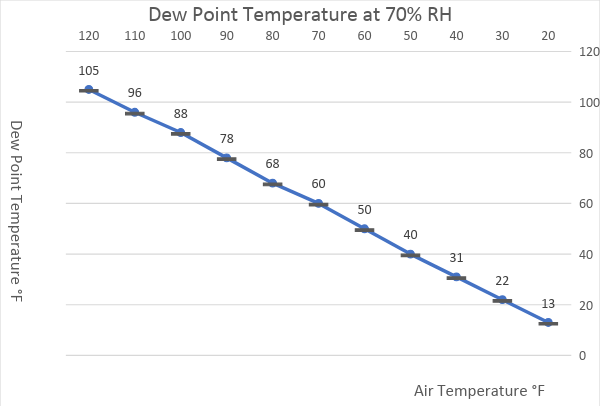
Graph of Dewpoint vs. Air Temperature at 70% Relative Humidity. Based on the Magnus-Tetens approximation.

This graph represents 70% RH. You may notice that at an air temperature of 70°F (X axis), the graph aligns with 60°F dew point temperature (Y axis). This means that if your greenhouse air is currently at 70% relative humidity at 70°F, you can go as low as 60°F before liquid water will appear in the greenhouse. If any surface in the growing facility reaches 60°F or below, water will condense onto it. Cooler surfaces are typically ceilings and walls, which have greater contact with the outdoors, metal pipes and railings, which can sit at different temperatures, or as we mentioned earlier, the plants themselves.


A SMARTER APPROACH

A combined approach, based on knowledge, allows us to do the minimum. We don’t mean minimum care, we mean minimum cost. Understanding what the dew point is and the factors that affect it provides us a better understanding of what’s really going on in our operation. What really happens when we heat up, or allow the air to cool down. It’s not just about temperature, it’s about humidity as well and the dew point encapsulates this.


Do you want to receive the next Grower’s Spotlight as soon as it’s available? Sign up below!


Resources:

  1. Want to get in touch with DryGair? They can be reached via the following methods:
    1. Website: https://www.drygair.com
    2. Phone: +972-9-7730980
    3. Email: info@drygair.com
  2. Want to read related articles by DryGair? Check these out:
    1. Ask DryGair: An eMail-In Question and Answer Series
    2. Ask DryGair: Humidity 101
    3. Ask DryGair: Ventilation vs. Dehumidification
    4. Temperature Management in Cannabis Cultivation
    5. HVAC Systems
    6. Is an HVAC unit enough for humidity?
    7. Using Climate Control to Prevent Disease
  3. Want to read about similar articles? Check these out:
    1. An Introduction to Closed-Loop Aquaponic Systems – Part 2 – The Nitty Gritty
    2. Vapor Pressure Deficit
    3. Condensate Reclamation – Practical Concerns
    4. Pro Tips: Curing Cannabis
    5. Tailored VPD for Cannabis Growth

Do you have any questions or comments?

Do you have any questions or comments?

Feel free to post below!


About the Authors

About the Authors

DryGair’s writers include a team of experienced engineers, agronomists, and economists. They specialize in climate control in closed growing facilities and practical solutions for effective climate management.


Motorleaf’s Vision for AI in Grow Operations

Do you want to be part of our private, professional community?
Join Now

In this Growers Spotlight, we spoke with the CEO of Motorleaf, Alastair Monk, about what his company is doing and their vision for Artificial Intelligence in the Cannabis space.

Alastair Monk

The following is an interview with industry experts. Growers Network does not endorse nor evaluate the claims of our interviewees, nor do they influence our editorial process. We thank our interviewees for their time and effort so we can continue our exclusive Growers Spotlight service.


Abbreviated Article


Editor's Note: Growers Network appreciates its readers! If you are limited on time, we are now offering abbreviated versions of our articles. Click below to view.

If you like the abbreviated article, let us know in the survey at the bottom of the article! We're always interested in hearing your feedback.

If you want to read more, you can read the full article below.


Implementing Artificial Intelligence

Montreal is the center of AI in the world right now.
Alastair Monk

The Market for AI

Cannabis production will become a race to the bottom in terms of what producers can charge for their product.Alastair Monk

About Alastair and Motorleaf

Enjoyed the article? Want to continue the conversation?
Join Now


Do you want to receive the next Grower's Spotlight as soon as it's available? Sign up below!


Want to get in touch with Motorleaf?

You can reach them via the following methods:

  1. Website: https://motorleaf.com/
  2. Phone: (888) 687-5301
  3. Email: info@motorleaf.com

Resources:

Want to check out some different controller and artificial intelligence companies in the cannabis space? Take a look at these:

  1. Motorleaf
  2. Kindbot
  3. Grow Diaries
  4. Argus Controls
  5. Wadsworth Controls
  6. Priva
  7. Link4 Controllers

Do you have any questions or comments?

Feel free to post below!


About the Author

Chris DeWildt is a graduate of Grand Valley State University and Western Kentucky University. In addtion to writing for Growers Network he is also a novelist


Evolutionary Origin of Cannabis: It’s a Little Fuzzy, Man

Do you want to be part of our private, professional community?
Join Now

In this article, Growers Network explores the origins of the Cannabis genus, looking at both the problems with genetic studies and the plant's historical use by early Homo sapiens.


Difficulties in Determining Origin


The biological genus Cannabis has a long, documented history of use by humans. Through archeological and historical evidence, researchers in various disciplines have been able to hypothesize a timeline of not only when Cannabis was first utilized by humans, but how it migrated with us as well. The natural history and biogeography of the genus before human utilization is hard to determine precisely, but genetic and archaeological evidence do give us a few clues as to its likely evolutionary range. Presented here is a partial summary of current scientific thought that will explain the hypothesized natural history of Cannabis, in addition to the evolution of the plant alongside humans.

Limited genetic research has been done to determine specifically where the oldest known populations of Cannabis exist and what their relationship to a common ancestor might be. Genetic research has focused primarily on whether any true speciation has occurred within the genus or whether the different “types” are just subspecies. This is difficult because the definition of a "species" can be a little squishy depending on whether you are talking to a biologist, cultivator, or a layperson. The simplest definition of a species is a population of organisms who can breed with one another and produce viable, fertile offspring. The entire Cannabis genus fits this definition, with all variations capable of breeding. This may seem to settle the issue, but another school of thought would argue that although the plants can breed, they don’t because of geographic barriers, and as a result should be considered different species despite their breeding potential. The literature is split on this topic, with some researchers proposing a single Cannabis species made up of three subspecies (sativa, indica, ruderalis) and others treating the subspecies as species in their own right. So despite the powerful tools at our disposal, there are already several questions that make determining Cannabis’ origins problematic before we’ve even started.

Then we need to tackle other issues preventing a clear picture of the Cannabis family tree. One of the first problems is the lack of fossil evidence prior to human use of the plant. Cannabis doesn’t tend to fossilize, given the locations it grows in naturally. Secondly, the characteristics that make Cannabis a relatively easy plant to grow also make it difficult to determine its point of origin; Cannabis can rapidly adapt to new regions and is an annual plant, so a high genetic diversity in a specific region is not necessarily indicative of antiquity. Even if we are able to identify “wild” Cannabis, it is most likely a “feral” variant with no real information about the ancestral type.


The result of these complications is that the best evidence to hypothesize the endemic origin of Cannabis is an examination of the ecological requirements of the plant and its reproductive strategies.

As mentioned previously, Cannabis is a relatively easy plant to grow (the nickname “weed” isn’t an accident). Cannabis will readily spread and grow without human intervention in the wild, quickly adapting to a variety of variable conditions within its range of ecological requirements. For example, the sun and heat loving Cannabis plant is more shade tolerant than other crop species, allowing for a wider range of suitable habitats. Even if we narrowed down likely origin spots based on these propagation requirements, we find that these hospitable ranges shifted several times during glacial and interglacial periods. So what do we know?

Not much.

The best hypothesis suggests that Cannabis originated in Central Asia, mostly likely within what are now the borders of China. Though this is a general consensus among many researchers, others hypothesize the location to be farther south into what is now India, Afghanistan, or even northern Eurasia.


Cannabis and Ancient Peoples


Though it’s hard to nail down exactly where Cannabis first took root, we have a better handle on the coevolution of the plant in relation to Homo sapiens. Given the ecology of the plant, its spread was inevitable. The working hypothesis is that around 10,000 years ago, most likely in central Asia, modern humans discovered the plant and found that the seeds were a valuable resource for food and oil as well as fiber for rope and eventually clothing. The oldest evidence of this use is in China where hemp fabric was discovered as well as hemp shoes that date back about five-thousand years.

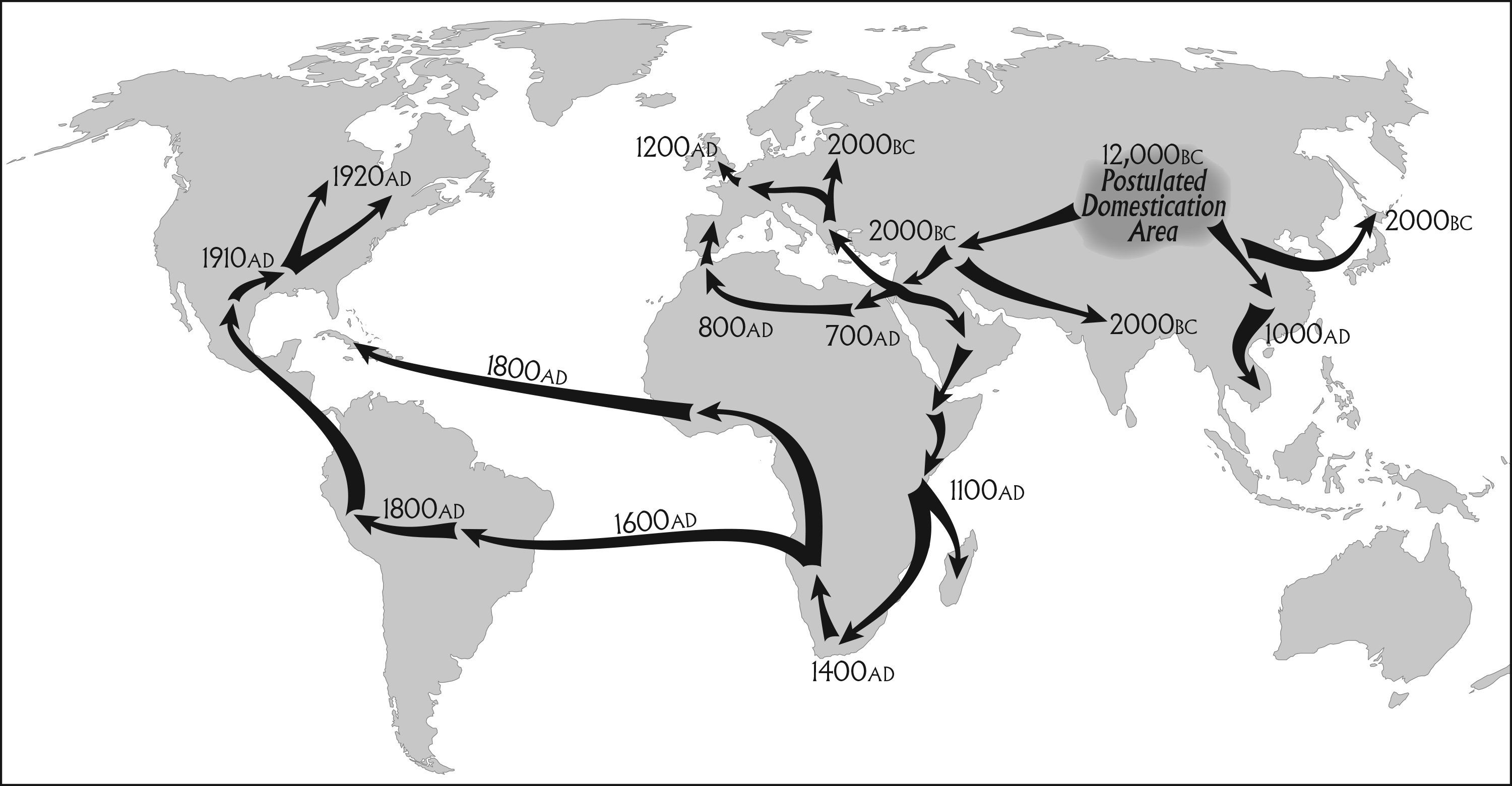
A proposed map of how Cannabis traveled with humans as they spread around the globe.

We know that Cannabis thrived in close proximity to humans, even prior to the advent of agriculture. As our ancestors utilized the plant, discarded seeds readily germinated and grew around their camps and latrines, and as a result the plants followed early humans as they traversed the old world continents. It’s not surprising we curious primates would utilize the versatile weed for everyday needs of survival, but when did we notice the intoxicating effects of the plant?

Most likely the psychotropic effects of Cannabis use were discovered when the plant was burned as campfire fuel, the smoke wafting through the air and inhaled as our ancestors cooked or rested or just tried to warm themselves. Our ancestors found themselves relaxed and calmed. It allowed them to forget their aches and pains for a time. This phenomenon would have been considered a welcomed distraction from the extreme hardships early humans faced, and it’s not surprising that Cannabis, and other psychoactive substances, were often considered a gift from the gods and incorporated into religious ritual and spiritual pursuits, and eventually even recognized for their medicinal properties.

It would be nice to be able to say with certainty where the Cannabis genus first appeared, but a logical hypothesis is all we have, given the nearly ubiquitous modern distribution of the plant. Hopefully, interested parties will soon fund a more comprehensive effort to determine the plant’s origin. A few efforts that have already shed a great deal of light on many of the anthropological questions surrounding Cannabis, and more research would go a long way.


Do you want to receive the next Growers Spotlight as soon as it's available? Sign up below!


About the author

Chris DeWildt is a graduate of Grand Valley State University and Western Kentucky University. He worked in education and publishing for ten years before joining the team at Growers Network. In addition to editing the GN blog, Chris also works on the Canna Cribs series.


Enjoyed the article? Want to continue the conversation?
Join Now

Integrated Pest Management

In this Growers Spotlight we interview Jordan Mello, the Master Grower for In Good Health, a state-licensed, non-profit medical marijuana dispensary located in Brockton, MA.

Jordan gives us an insider view on Integrated Pest Management (IPM), and explains why MA IPM policies will most likely have an impact on current and future state regulations with regard to cannabis testing, quality control, and pesticides.

If you have any questions related to IPM, growing in MA, commercial cultivation, or direct questions for Jordan, you can post in the comments section below.

What is the definition of IPM?

Integrated Pest Management (IPM) is the careful consideration of all available pest control techniques and subsequent integration of appropriate measures that discourage the development of pest populations and keep pesticides and other interventions to levels that are economically justified and reduce or minimize risks to human health and the environment. IPM emphasizes the growth of a healthy crop with the least possible disruption to agro-ecosystems and encourages natural pest control mechanisms.To skip to any section within this article, click the links below:

  • Massachusetts’s Integrated Pest Management
  • Jordan Mello’s IPM Regimen
  • Grower’s Network Questions
  • Resources
  • Comments
  • Jordan Mello's Grow Operation By the Numbers

    (Size) 8,500 sq. ft. of canopy.

    • Propagation: 500 sq. ft.
    • Veg Rom: 1000 sq. ft.
    • Flower Room: 6,500 sq. ft.

    (Lighting equipment)

    (Media)

    (Nutrients)

    (Feeding Style) Currently hand watering drain to waste. Looking into automated Argus and Dosatron systems.

    Elaborated Explanation of Growing Operation

    Propagation

    (Size) 10’ x 20’ with multiple levels, we are making more room per square footage that the floor plan shows. (Lighting equipment) T5 lights, I use 4′ – 4 bulb units because I have found that 6 bulb units are too intense. (Media) We use the Grodan Rockwool A-OK sheets. There are like 98 plugs per sheet. We used peat plugs to start out with, and then our cloning needs got to the point where it was way too much maintenance. They dry out way too fast. We could not get as many of those in one dome as we could with the sheets. So we switched over to the Grodan Rockwool.

    Vegetation

    (Size) 1000 sq. ft – Once they transplant from propagation, they are moved into a 20’ x 20’ room, in which we also use rack system. There are 2 aisles, and each of those have 3 levels. In that room, we are working with about 400 – 500 plants at any given time, which is about 2 cycles for us. (Lighting equipment) LumiGrow Pro 650 High Voltage (HV 480v). (Media) Once we move from Grodan Rockwool, we transplant into 1 Gallon Premium Nursery Pots via Pro-Mix HP. Although, we are switching it up after this harvest, and we are going to go straight coco. We are looking at those Canna Coco Bricks because they tested clean through MA state for pesticides, heavy metals, and plant growth regulators (PGRs). All of our media needs to be lab tested. The coco bricks are a huge space saver when you are working with commercial grow styles. For me to stock as much Pro-Mix I need for the year, it is a whole warehouse. The compact nature of the coco bricks is going to be great. We use Pro-Mix after that as well, when we transfer them into 7 Gallon Premium Nursery Pots as a final pot. (Feeding Style) We do hand watering right now, but that is going to be changing soon. The original director of cultivation had set it up because originally MA required us to use 100% organics, even nutrient-wise. And the reason they changed it was because of the heavy metals. So the original director was not comfortable setting up an irrigation system for organic stuff like that. His ultimate goal was to kind of use a super soil type of system. Where it was just hand watering plain water. To do it on this scale would be something else! Unless we were buying the soil, the cost would be astronomical. You would be introducing all types of pests with that organic mass-produced soil. It was just an option we tried to get around.

    Automation

    We are in the process of redesigning the room to be automated. And the other two rooms, once they are built out, will be automated as well on that system. We are going to go with the Argus system because it can do every room where we have every individual irrigation loop. It is a pretty straight forward system to use. I have only seen it used in one other place. It can get pretty sophisticated, down to putting specific PPM of each element into your mix. The customization on it is top notch! In the smaller veg. rooms where less nutrients are needed, we are utilizing Dosatrons. In the bigger flowering rooms, where there is more work to be done, we will be using the Argus system. The feedings are a couple times a day, instead of once a day.

    Flowering

    (Size) Approximately 6,500 sq. ft. of flowering space, divided into 4 rooms. The 2 biggest rooms are 80’ x 24,’ then a 63’ x 24,’ and a 59’ x 20.’ (Lighting equipment) Those are all lit with LumiGrow Pro 650w LED Grow Light with Tri spectrum fixtures. (Media) Pro-Mix HP in 7-Gallon Premium Nursery Pot. (Feeding Style) Automated feeding regimens with the argus system.


    Massachusetts’s IPM

    What is Massachusett's Integrated Pest Management (IPM) and what makes it different?

    Massachusetts IPM laws mandate the use of non-synthetic, organic pesticides only. In order to meet these requirements, we adhere to USDA standards for organic produce. Because organic pesticides don’t last as long as synthetic varieties (such as Eagle20), we have to apply pesticides more frequently. We apply pesticides about 3 days a week, with a rotation of Biosafe Systems ZeroTol, a neem oil product, and Procidic. Other organic methods of pest control are “bio-pesticides” and “bio-fungicides.” These are bacteria or fungi that act like pesticides, keeping the dangerous and unhealthy organisms out of the product. Massachusetts law also requires microbiological screenings of the product. Unfortunately, microbiological screenings don’t distinguish between helpful bacteria/fungi and harmful ones. If you use bio-pesticides, you are risking failure of the microbiological screenings. Some people say that Photosynthesis Plus works well as a foliar spray, but it could make us fail our tests for bacterial counts. This severely constrains the kinds of pesticides we can use. The problem can be avoided by using the bio-pesticides early in the plant’s life cycle, although it severely limits the bio-pesticides use. Additionally, Massachusetts law has stringent limits on the amount of heavy metals present in our product. We are required to be 5 to 10 times lower than any other state that regulates heavy metals. The metals we look for are cadmium, mercury, arsenic, and lead. We test every pesticide and nutrient we receive for the presence of heavy metals. The biggest problem with testing for heavy metals is that the results can be wildly inconsistent. We can test the same batch 5 times, and get 5 different results.

    Did you hire an IPM consultant to help you build your IPM regimen? If not, how did you learn IPM?

    The state gave us regulations and told us how to set them up. We brought in urban-gro, an IPM-specialist company. Consultants are not required, but definitely a beneficial thing to have, because a lot of the companies that design HVAC systems really failed the first couple dispensaries in the New England area.

    Do you think IPM is going to be a nation-wide practice required for growers cultivating cannabis?

    IPM has been a requirement in Washington state since they passed i502. They were the first to push for limiting the amount of pesticides allowed. From a consumer point of view, it is strange that the recreational side of Washington implemented pesticide monitoring, but the medical side didn’t do it. If I were to predict anything, the programs that MA, CO and WA have are going to be the base models for the rest of the country to follow. As California votes in November, bigger companies will emerge and it will become easier to regulate the industry.

    How does Massachusetts monitor your pest management system for your commercial garden?

    We are subject to 2 site visits per month. One site visit is random, and the other one is announced. The inspectors go through the entire building. They inspect the grow and ask us to disclose the new products and pesticides we are using. Along the way, they ask for our MSDS sheets and SOP’s (standard operating procedures). Their unannounced visits are impressively unpredictable. It keeps you on your toes. You never know what they are going to be asking for this time. When it comes to the IPM testing:

    1. Every product gets tested. If I’m sending them a batch of flower for sale, they test cannabinoids, heavy metals, pesticides, plant growth regulators (PGRs), full microbiological screening and then mycotoxins.
    2. When the flower is going to be converted into oil, it will only be tested for pesticides, heavy metals, and CFCs.
    3. Every single finished product, no matter what it is, gets a microbiological screening before it goes out.

    We apply pesticides about 3 days a week, with a rotation of Biosafe Systems ZeroTol, a neem oil product, and Procidic.— Jordan Mello

    Jordan Mello’s IPM Regimen

    Regulations change constantly. You need to cover your bases and be cautious on things you bring in.— Jordan Mello

    What problems have you run into with your IPM?

    We have kind of seen it all, including thrips, spider mites, and powdery mildew. Now the goal is maintaining a standard and staying ahead of the game. With IPM, it is all about preventing pests from getting in. Editor’s Note: Here is a quick link to Massachusetts’s state laboratory testing protocols.

    How do you deal with pests?

    Thrips: We use spinosad, which is a biopesticide. Initially it was a banned pesticide, despite the fact that it is organic. Now I only use it early during growth because of the microbiological testing. The Spinosad knocks thrips out by about 80% in the first application. For the other 10-20%, I use a product called Azagard (Biosafe Systems). The great thing about Azagard is you can tank mix it with ZeroTol. Spider Mites: These are even easier to wipe out than Thrips. We used Azamax when we first identified spider mites, well before we had plants in flowering rooms. Every other day for 10 days, we used Azamax on every plant in the building. We have not seen spider mites for a year and a half since then, knock on wood. Powdery mildew: We use a combination of the Procidic from urban-gro and ZeroTol. It is just an alternation between the two. Powdery mildew replicates, and it is really difficult to get rid of it with just ZeroTol. Now we are at the point where it is under control, and we are doing maintenance. The combination of the two is pretty much unstoppable. If I’m doing a maintenance spray with the ZeroTol, I might as well do a maintenance spray with Azaguard and kill two birds with one stone. It makes it really easy, in terms of cutting down labor.

    How do you integrate IPM into your workers’ routine?

    At this time of the year in New England, our IPM requires that every employee who comes into the grow area must change out of their street clothes into scrubs. We have in-house shoes with booties on top as well. From there, they must regularly change their gloves, booties and hair nets. It is a matter of keeping themselves clean and avoiding cross-contaminating different rooms. If I have thrips in one room, I want to keep them in that room. I want to isolate the problem, and then attack them. Right now, all of our employees are required to:

    1. Come in and switch out of their street clothes
    2. Equip their in-house shoes with booties on top
    3. Put on their in-house scrub type work clothing
    4. Wear black nitrile gloves and hair nets

    Each room will have have a lab coat for that room. It instills good habits and isolates rooms from each other without taking too much time out of their schedules.

    Have you ever used beneficial insects in your garden? If so, which ones and how did that work out?

    We have never used beneficial insects at this grow, although I have used them for my previous, smaller grows. I have never used them on this grow because of the risk of what other biologicals the insects might bring in. One issue with the evolving cannabis industry is that regulations change constantly. You need to cover your bases and be cautious on things you bring in.

    What advice would you give to someone who is designing their grow operation from ground zero, and needs to take a heavy IPM into account?

    If you are going to have strict standards of what you can and cannot use, you need to start with design first. Jumping in headlong and expecting good results will not work. Do not be afraid to reach out to people you know that are in the community and ask. That is why it is so beneficial to reach out to groups like urban-gro that consult for multiple people. They have experts in pest management, lighting, and more. My other big suggestion is that you should be aware of people who call themselves “experts”. We have had 3-4 consultants that have come in claiming to be experts, and urban-gro showed that they were wrong. It is an interesting industry and finding people to trust is tough. Editor’s Note: If you want to learn more about MA IPM, you can visit their state website.

    Growers Network Questions

    The interesting thing about my job is that none of my days are ever the same.— Jordan Mello

    What are your favorite 3 products that you’re currently using?

    1. Biosafe Systems ZeroTol — anything biosafe is great! We use their SaniDate to clean our hard surfaces, but their ZeroTol is probably my number one.
    2. Myron L’s PH pen, aka “Dexter’s Lab pens”. Those things are awesome! They make it so easy to test my run offs, I literally just have a little pen in my pocket that can literally tell me down to the 1/100th of a pH.
    3. When we are dealing with lights, we prefer the Method Seven Green Lens LED glasses. You cannot see anything under purple lights, so it allows you to see details in the plants and pay attention to exactly what is going on.

    Who has had the biggest influence on your knowledge and style of growing?

    I think that I’ve always had the mentality where I try to pull from a lot of different people. There was never just one person that I really followed. What the Jungle Boyz are doing out in LA is top notch. Every time I go on Instagram and look at the Jungle Boyz, I have to stop, because they make me envious! They have it down to a science. It is going to be really interesting to see what happens in California if they adopt these regulations that these other commercial states have.

    What is your typical daily routine?

    The interesting thing about my job is that none of my days are ever the same. I’m in charge of the grow, but I also do managerial and administrative work throughout the entire operation. I get in early before everyone else, to set up my guys’ tasks for the day. Then when I go to the lab, where I’m managing again. I’m not the only one doing any of those things, but they are my secondary role. I also handle project management on the construction side. We check runoff three times a week for PH and EC and making sure all of our flushes are going well, while making sure our nutrients are not too high or low. I’m in charge of all cloning duties, except transplanting them. My harvest schedule is already set for the next 2 years. Every room is planned ahead of time, which is obviously subject to change as the situation merits. A lot of my week just goes to maintaining inventory and putting the protocols in place to make sure our inventory is in line. And then I call Growers House to make sure we have all of our nutrients and stuff like that. And then I work with the state inspectors when they come in and answer their questions. This is all just an example of what could happen in 1 week for me.

    If you were given 1 million dollars today to invest in your grow operation, how would you spend it?

    1. First thing I would do is automate watering. Let’s call that $200k, being conservative.
    2. After that, I would invest in solar panels, which cuts down a huge chunk of cost to produce. If I can get production cost down, it means more money for us.
    3. I would probably invest the rest on double-ended, high-pressure sodium lights and mix them in with our LEDs. Our yield could be better in terms of what we could be producing off of the hyper sodium lights.
    4. These tools would cut our production costs in thirds. At that point, it would be a couple dollars per gram. This is our first year of operation, so I had to break down to the penny, what it costs to produce an ounce, including. electricity, water, labor, nutrients, soil. It roughly comes out to $35/oz to produce. My goal is minimizing that number!


    Do you have any questions or comments?

    Do you have any questions or comments?

    Feel free to post below!


    Resources:

  • How to manage Spider Mites — University of California IPM
  • Pesticide use in Cannabis Production — Beyond Pesticides
  • Pesticide Database — Pesticide Action Network
  • National Organic Program — USDA
  • IPM 6-Step Approach — MA Energy and Environmental Affairs
  • IPM Kit for Building Managers — MA Department of Food and Agriculture Pesticide Bureau

  • Do you want to receive the next Grower’s Spotlight as soon as it’s available? Sign up below!



    Do you have any questions or comments?

    Do you have any questions or comments?

    Feel free to post below!


    About the Author

    About the Author

    Hunter Wilson is a community builder with Growers Network. He graduated from the University of Arizona in 2011 with a Masters in Teaching and in 2007 with a Bachelors in Biology.